Thinking Critically When Reading News

读《Asking the Right Questions》后感
Many people today value critical thinking a lot, but what does “critical” mean? Which methods should we take to become a critical thinker? The book Asking the Right Questions tells us some specific steps to evaluate whether articles are organized logically and how good it is. These steps help us to think independently rather than being led by authors totally. An accident happened a few days after I finished the book, and I found some interesting facts contributing to better understand the critical thinking measures to some extent.
The news was that Notre Dame Cathedral was on fire on 16th, April. It was quite a shock for the world as Notre Dame was famous for being the significant architecture of the gothic period. People shared this news immediately and it quickly spread everywhere on social media. The interesting thing is I saw a number of people saying, “Quasimodo lost his home.” on Weibo and WeChat. The sentence was so touching that a feeling of sadness raised right after I read it. I was about to feel sorry for Quasimodo at that time, however, I coincidentally read an article about the accident and the author especially stressed that the bell towers survived. Did Quasimodo lose his home or not? With this question, I searched for some news about it on the Internet and found that as a matter of fact, the bell towers had survived. So why people felt sorry for Quasimodo even knowing so little about which part was destructed?
Asking the Right Questions explains the above phenomenon. We are easily distracted by some emotional expressions. Words and sentences with strong emotional impact are ambiguous but powerful which are always used to call for feelings and ignorance of the accuracy of the information. This fallacy was called “appeal to emotion”. And I think it is the most common mistake we would like to make both in the role of writers and readers. Preventing ourselves from this fallacy requires awareness of expressions which are full of feelings. The vital thing is do not believe someone unless he or she provides a clear picture of his or her reasoning. Always asking questions like “what do you mean by saying that?” can help us to avoid emotional traps.
Take the sentence “Quasimodo lost his home.” for instance. Let us consider the reason why people are so touched by this sentence. As long as you are familiar with the famous book The Hunchback of Notre Dame, you’ll understand that Quasimodo represents tragedy and virtue. A man with an ugly face but beauty inside now lost his home. It was so dramatic and despair that everyone tends to feel sorry for him. Nevertheless, if you are a critical thinker, you will be aware of something underneath the strong emotion. This sentence is very ambiguous. It didn’t tell explicit facts about the fire.
Let’s think one step further. Why did the writer write it? It is hard to find who originally wrote the sentence. But we can be sure that the writer saw the news about the fire and may also watch the video of it. He or she saw the news superficially without figuring out which part of the cathedral was ruined or damaged. The feelings of losing a great Gothic architecture that happened to be the home of the famous character took control of the author, stopping him/her from thinking deeply. Driven by the strong emotion, the author wrote the sentence which impressed a lot of people for the similar reason. We should not criticize those people as we all know emotion is powerful and it can create positive effects in many aspects. However, it doesn’t mean that we should allow the emotion part to take charge of our mind with ignorance of the rational part. Emotion contributes to sympathy while reasoning determines whether the sympathy is consistent with the facts. Before getting touched we need to consider the relation between the facts and the emotions. The group of Mimeng once wrote an article which gained more than 10 thousand times of sharing. It mainly criticized the pursuit of money in the materialistic society because people lose their sincerity and honesty on the way to become rich. The article told us a story of an outstanding boy from a poor family died because of heavy burden. It indicated the unfairness and money-oriented phenomenon which are exactly what most of us think about the current world. However, the story turned out to be totally made up. The boy was not a real person and the total thing was just a novel. Although the public know the truth now, they can’t forget the anxiety and depression when they read the article. In other words, the emotion already occurred may not be so easily eliminated. So, it is vital for us to judge the evidence before any emotional reaction appears. Noticing the distortion or the mismatch can keep ourselves walking on our logical path. For me, critical thinking requires logical mind primarily. Only if you keep on seeking the connections of the reasons and conclusions will you be aware of emotional attraction and stay away from being misled.
With the development of digital technologies, so much information along with many resources require the crowd to choose from them. In order to attract people, writers like Mimeng sometimes use emotional contents to distract readers from focusing on the logic. The well-known socialist Gustave Le Bon in his book the Crowd: A Study of the Popular Mind said, “the masses have never thirsted after truth...whoever can supply them with illusions is easily their master; whoever attempts to destroy their illusions is always their victim.” The public is much easier to be manipulated with the development of social media and other digital technologies. The massive news on the internet dazzling our eyes and obscuring the truth. The phenomenon indicates the importance of judging the reliability of the resources.
During the days when people discussed the damage situation of Notre Dame, I found conflicts on people’s information. The west rose window is a central issue in the tragedy because of its fame and beauty. While a friend of mine saying the window was destroyed, another friend responded that the window survived. The discussions on the internet are more confusing. A thousand people have a thousand information about the level of damage, and everyone insists that he or she was right. It led out the question of evaluating the evidence. In chapter 8 and chapter 9, the author focuses on the advantages and disadvantages of various types of the evidence. These chapters can help us judge the evidence when we read the news via the Internet. One thing is that “you should be more impressed by primary sources—or direct observers— than by secondary sources, those who are relying on others for their evidence.” The primary sources mean where information originally comes from. For example, the video of the cathedral or reports on site can be seen as primary sources of Notre Dame fire because they came right from the scene. The reports on line and articles in WeChat subscriptions are secondary sources as they have been reorganized and edited. The advantage of the primary sources is that they are more objective with little distortion. If you have watched the video of the fire carefully, you’ll find out two towers are intact and rose windows show no signs of destruction.
However, comparing to the massive secondary sources, the primary sources are always limited. So, it is also of great importance to use the second-handed sources properly. The first-handed resources mainly provide some information on site right after the fire blazed, while second-handed resources can help us follow the subsequent situation. Choosing the resources according to their credibility is critical. Medias such as BBC and CNN are more reliable than the articles in WeChat as they are more professional and objective. In the book Asking the Right Questions, the writer uses “authority” instead of media. The trustworthy authority depends on the carefully evaluation of evidence. Asking questions like “Has the authority developed a reputation for frequently making dependable claims?” and “Have we been able to rely on this authority in the past?” can assist us to decide whether the evidence authority shows is worthy of trust. BBC and CNN are official channels of the UK and US, and they aim at providing dependable news. They have done well for many years without big crisis of reliance. Also, with correspondents and reporters all over the world, the collection of information becomes much easier and on time. The professional and strict attitude towards information analysis contributes to the credibility, too. The following picture on the web of CNN which updated in 6 hours after the accident happened shows the damage part of the fire. It clearly tells us the construction of Notre Dame cathedral and which parts were seriously destroyed.
|
The illustration of the situation of fire damage provided by CNN |
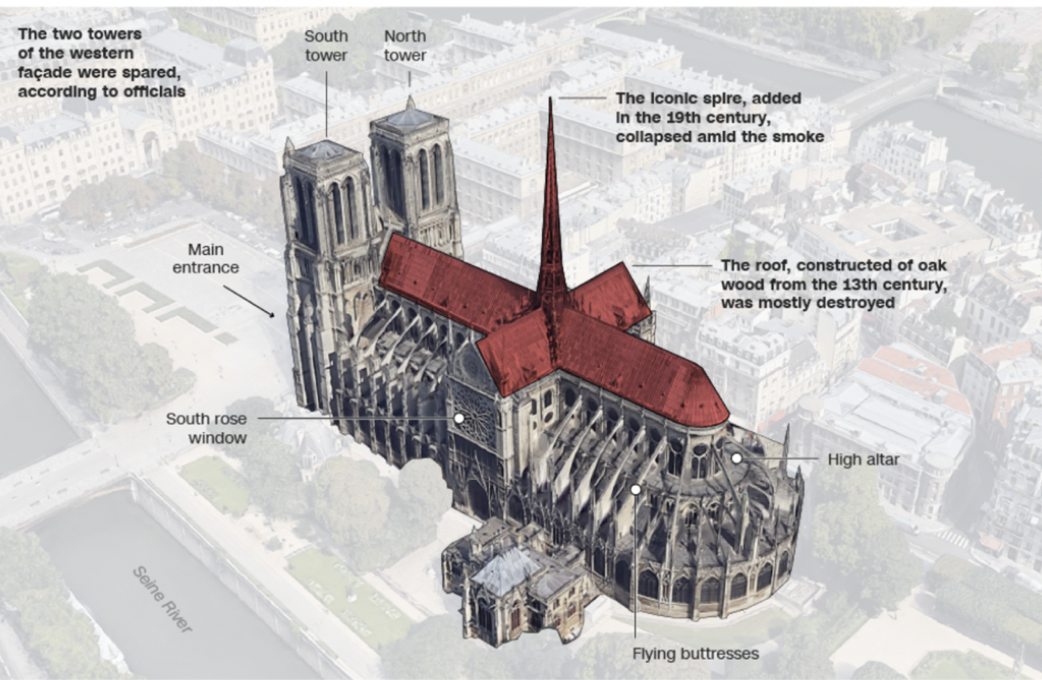
CNN also reported the situation of valuable works of art. According to its report, the Culture Minister Franck Riester said the most precious ones such as the "crown of thorns" and the "tunic of Saint Louis" had been moved from Notre Dame and are now being held under security at Paris City Hall. And the worst affected part of the church was the spire, built in 19th, collapsed as the video showed. In addition, the framework from 13th was completely lost in the fire. The official announcement in the report also contributed to credibility a lot because it came from people who are in charge of the accident. No one else knew clearer how the situation was than those people. And the information they showed was clear without ambiguity. It told the public about the situation of the works and where they were moved to. Direct reference of officials’ words can also strengthen the sense of trust as it shows the report does not misunderstand or distort the meanings.
By now, I have reviewed the news of Notre Dame fire and the mistakes I have observed during the discussions with friends and Netizens. Using the methods in Asking the Right Questions, I try to figure out what critical thinking ways we can use when reading news today. The vital thing is keeping thinking all the way and questioning the reliance. Besides the emotional traps and the evaluation of authority, we need to pay attention to the videos and photos that are attached to the news. The fast growth of digital software challenges the old saying “seeing is believing”. The saying no longer works as what we see can be artifacts and may be distorted by the software. also, different perspectives the recorders have will create prejudice. In the future, the development of artificial intelligence will shake the evaluation of truth definitely. As it is impossible to change the trend of the progress of technology, we can only keep thinking and asking while facing the news today and tomorrow. Personally, I would regard the book as ways to develop thinking skills rather than judging whether the news is true. Truth can be incomplete and relative, and the news inevitably would have some preference when reporting. One thing we can do is trying to collect as exhaustive information as we can in order to have a more complete aspects of the event, another thing is keeping questioning and thinking as the book indicates. In 17th century, the famous philosopher Descartes said, “I think, therefore I am.” Beneath the sentence is the idea of general suspicion. What the great philosopher asked us to do is exactly the world requires us today: doubt everything. And that’s the vital thing of critical thinking.
Gustave Le Bon had a quite negative impression of the public. He thinks the mass who lack of rational are impulsive and emotional. The passive aspect of the public exists on social media with some unreasonable comments and ventilation of emotions. It is true that people are much easier to be manipulated and incited when they are in groups. However, we can also see some positive changes happening. When Netizens were touched by Mimeng’s article, someone stood out asking the credibility of the story. And with more and more doubtful news appear on the Internet, more voices come to question whether news and articles are dependable. Perhaps with more critical thinkers appearing, the authorities will be much more responsible for what they say online.