荣获MuseAwards银奖后,官方采访稿分享,对AI时代处于成长迷茫的设计师或许有启发


北京/艺术工作者/106天前/423浏览
版权
荣获MuseAwards银奖后,官方采访稿分享,对AI时代处于成长迷茫的设计师或许有启发
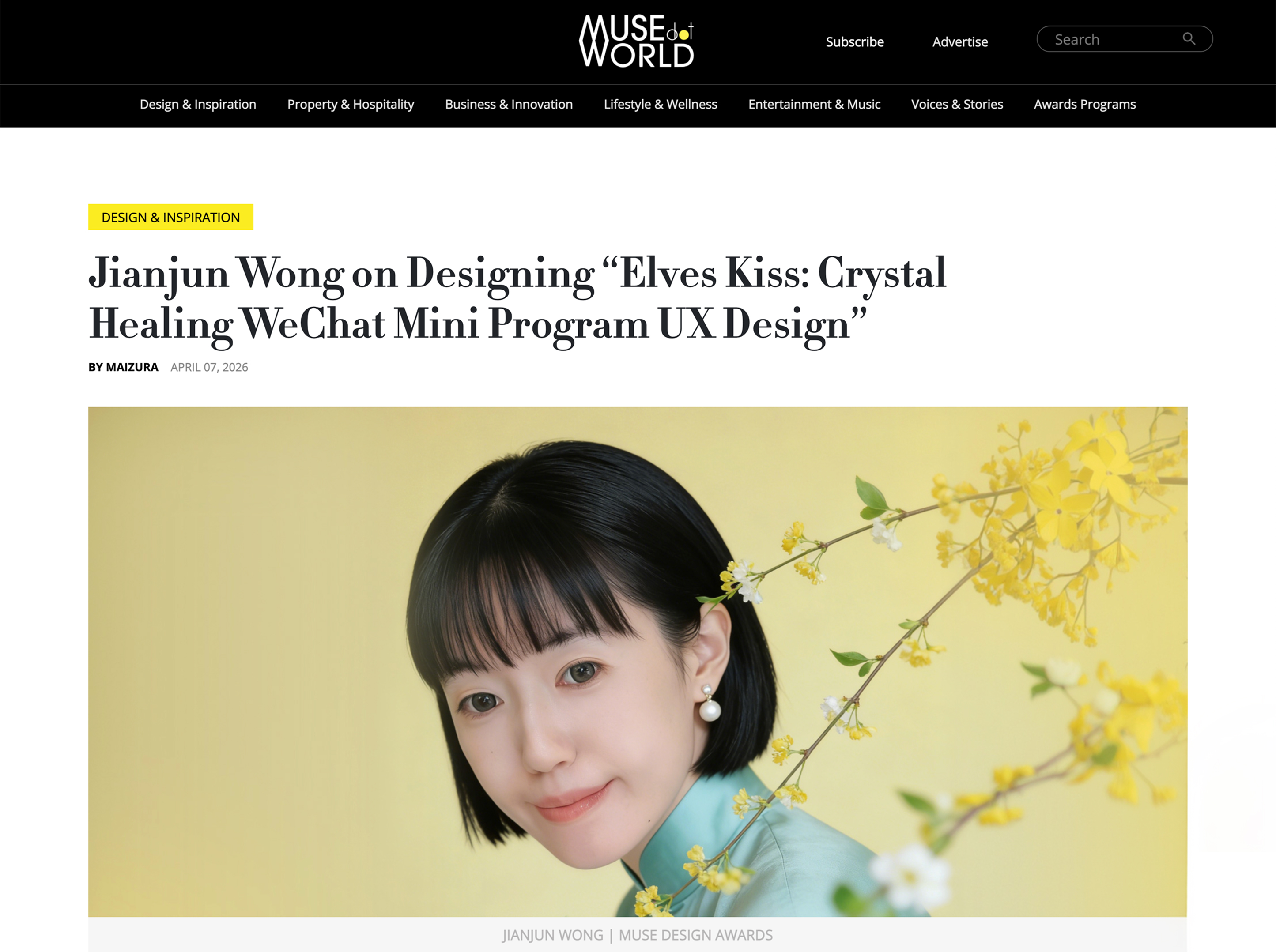
见珺目前专注于人文与身心灵(感知设计),核心研究方向在于人类经验、材质表达与氛围、情感共鸣等不可见特质之间的关系。依托十余年 UI 设计及以用户为中心的设计经验,将数字逻辑与物理材质、空间探索相结合。从界面设计延伸至产品体验及“人类感知设计”——探讨个人如何被感知,以及如何通过设计更精准地传达个体的存在感与特质。通过结合系统化的设计方法论与敏锐的感知力,致力于“让不可见变得可感知”,将复杂的体验转化为清晰且富有意义的形式。(主页查看过往核心作品)
Q1. Congratulations on winning the MUSE Design Awards! Can you introduce yourself and share about what inspired you to pursue design as a career?
I believe it started with an instinctive pull toward design. Although I majored in History during my undergraduate studies, I chose to follow my genuine interest after graduation and stepped into the field of UI design, where I have been deeply engaged for over a decade.
Throughout these ten years, I’ve continuously refined my skills and gained experience. More importantly, I’ve come to see design not just as a profession, but as a way of connection — connecting with the world, with myself, and with my clients on a deeper level. That sense of connection is what makes design truly meaningful to me.
Q1. 恭喜您获得MUSE设计奖!能否请您自我介绍一下,并分享一下是什么启发您将设计作为职业选择?
最初是出于一种近乎本能的吸引力。虽然我本科主修历史,但在毕业后,我选择遵循内在的兴趣,转而进入 UI 设计领域,并持续深耕至今已有十年。
这十年里,我不断打磨自己的专业能力,也逐渐意识到,设计不仅是一项技能,更是一种连接的方式——它让我与世界建立联系,也让我更清晰地理解自己,并与不同的客户产生深层的共鸣。这种连接,本身就是设计最迷人的部分。
Q2. What does being recognized in the MUSE Design Awards mean to you?
To me, this recognition represents an important milestone.
Submitting this project was actually not part of my original plan — it was more of a spontaneous decision. However, the MUSE Design Awards has always been a platform I admire. This particular project also had a strong foundation, as the client’s product itself was exceptional, allowing me to bring together and fully integrate my previous experience in mind-body-spirit-oriented design.
In a way, this work is not just a single project, but a concentrated expression of my design thinking over a period of time. Being recognized by the MUSE Design Awards is both a strong encouragement and a meaningful milestone in my journey as a designer.
Q2. 获得 MUSE 设计奖的认可对您来说意味着什么?
对我来说,这是一次非常重要的阶段性认可。
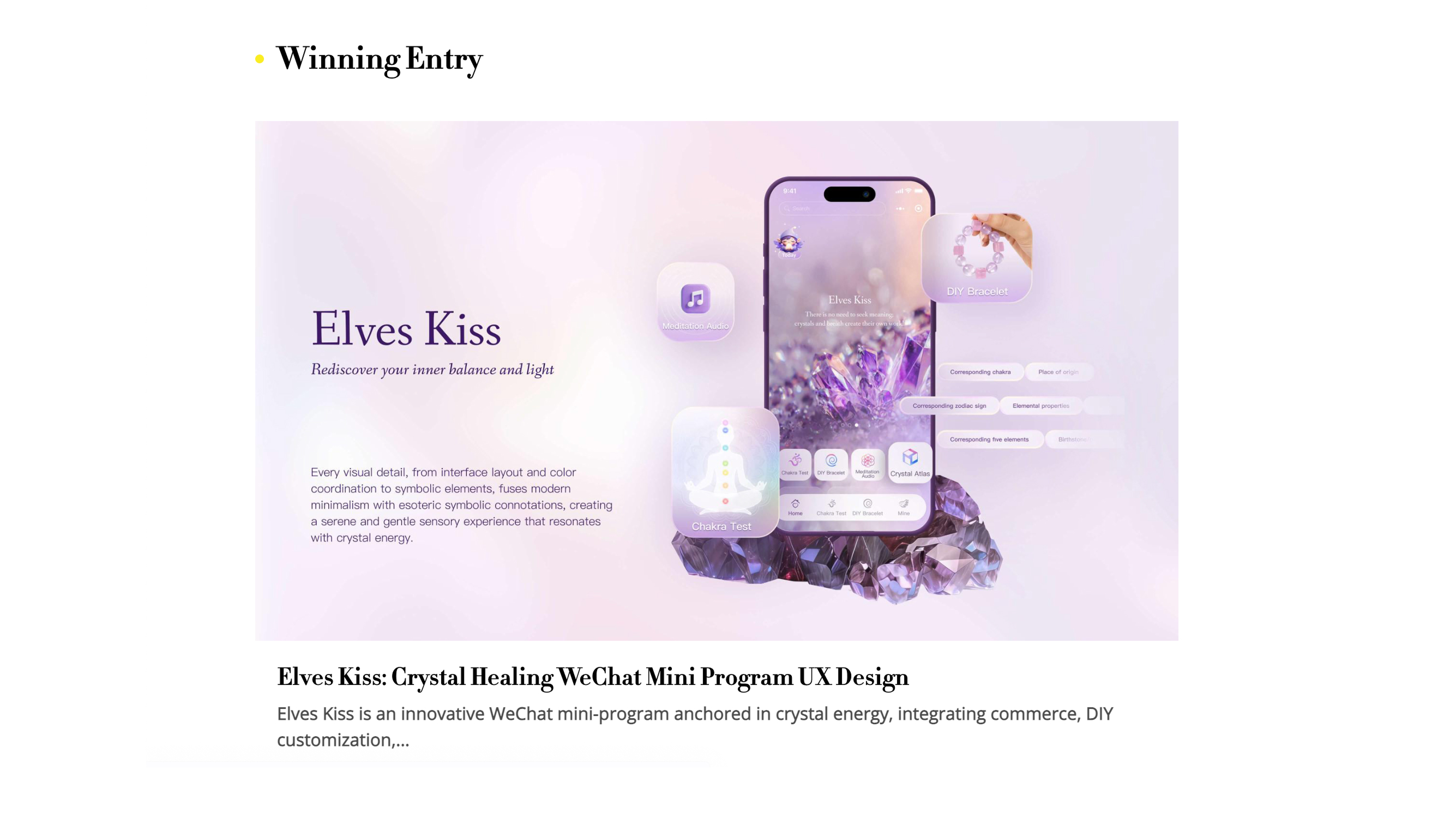
其实这次申报并不在原本的计划之内,更像是一次顺势而为的尝试。但缪斯设计奖一直是我关注和向往的平台,而这个项目本身也具备很好的基础——客户的产品非常出色,因此我得以将过往在身心灵方向的设计经验进行一次更完整的整合与表达。
某种程度上,这个作品不仅是一个项目成果,更是我过去一段时间设计思考的集中呈现。能够被缪斯设计奖认可,对我来说既是一种鼓励,也标志着我在这一方向上的一个重要里程碑。
Q3. How has this achievement impacted your career, team, or agency, and what opportunities has it brought so far?
As this recognition is still very recent, the concrete opportunities it brings are still unfolding. However, what matters more to me at this stage is the sense of direction it reinforces.
This year, I transitioned from working in a leading internet company to becoming an independent designer (and gradually shaping my own studio practice). Receiving recognition from the MUSE Design Awards at this particular moment gives me strong validation that my exploration in mind-body-spirit-oriented design is both seen and valued. It also helps guide my future direction — from the projects I choose to the way I express and deepen my work, I am becoming more focused and intentional... (站内超字数省略)
Q3. 这项成就对您的职业生涯、团队或机构产生了哪些影响?迄今为止,它带来了哪些机会?
这个奖项来得很快,所以它带来的具体机会还在逐步展开中。但对我来说,更重要的是它在当下所产生的“方向确认”。
今年,我刚从一线互联网公司转向成为独立设计师(或工作室形态)。在这样的阶段节点上获得缪斯设计奖的认可,让我更加确信,自己在身心灵设计这一方向上的探索是被看见、也是被认可的。这种确认感,也在引导我未来的路径选择——无论是在项目筛选、表达方式,还是设计深度上,我都会更加聚焦和坚定。
与此同时,它也在无形中打开了一些新的连接。无论是与客户的沟通,还是外界对我工作的理解,都变得更加顺畅。这种“被理解的效率提升”,其实正是机会开始发生的前兆。
此外,今年11月我也将前往吉隆坡参加颁奖典礼。对我来说,这不仅是一次线下的国际交流机会,也是一个将自己带入更广阔设计语境中的重要节点。
我更倾向于把它看作一个起点,而不是结果。
Q4. What role does experimentation play in your creative process? Can you share an example?
For me, experimentation is not a separate stage, but a methodology that runs throughout the entire creative process.
In my work, I pay close attention to intangible aspects — such as atmosphere, subtle presence, and forms of energy that continuously influence perception yet cannot be directly measured. Essentially, my creative process is about translating the invisible into something perceivable through design.... (站内超字数省略)
Q4.在你的创作过程中,‘实验性尝试’(或‘创新探索’)扮演了怎样的角色?你能分享一个例子吗?
对我来说,创新探索并不是一个阶段性的动作,而是一种贯穿整个设计过程的方法。
在我的设计中,我会特别关注那些无形的层面——例如气场、状态,以及那些持续影响人感知却难以被量化的能量。因此,我的创作本质上是在做一件事情:尝试通过可见的设计语言,让这些无形的存在被感知。
具体来说,我会借助光、材质以及空间关系的变化,让感受在视觉中被“显化”出来。比如通过光的流动与反射、材质的通透与层次,以及结构所形成的空间张力,去承载一种稳定而清晰的状态,而不仅仅是形式上的呈现。
以这次获奖的项目为例,我在不断调整水晶的组合与光感关系,让这些无形的感受能够被放大,并转化为一种可以被真实体验到的整体氛围。
这个过程本质上是一种持续的实验——去验证,是否能够通过设计,让不可见的能量被具体地感知。
Q5. What's the most unusual source of inspiration you've ever drawn from for a project?
For me, inspiration is not confined to a single domain, but rather emerges from identifying shared qualities across different dimensions.
On one hand, I often begin with human states, using internal perception as a starting point. On the other hand, I draw from nature and local cultural contexts — such as material expressions, spatial atmospheres, and the sense of time embedded within them.
For example, in a previous project, I was inspired by the restraint and subtle warmth of Ru ware, as well as the strong sense of locality and spatial order found in Aman resorts. Although these references come from entirely different fields, they share a common sensibility. I translated these qualities into the design of an educational product.
In this sense, what makes my source of inspiration unusual is not the source itself, but the process of crossing disciplines — extracting and recombining shared perceptions, and ultimately translating them into design language.
Q5. 你曾经为某个项目汲取过的最不寻常的灵感来源是什么?
对我来说,灵感并不局限于某一个具体领域,而更像是在不同维度之间寻找“相似的感受”。
一方面,我会从人的状态出发,把内在的感知作为设计的起点;另一方面,我也会从自然环境或在地文化中获取灵感,比如不同地域的材料语言、空间氛围以及时间沉淀所形成的质感。
例如在过往的项目中,我曾从汝窑的克制与温润,以及安缦酒店所呈现的在地性与空间秩序中获取灵感,并将这些特质转化到一个教育类产品的设计中。虽然它们来自完全不同的领域,但在感受层面却存在某种共通性。
因此,对我来说,灵感的“非常规”之处不在于来源本身有多特别,而在于如何跨越领域,提取并重组这些相似的感知,并最终转化为设计语言。
Q6. What’s one thing you wish more people understood about the design process?
I wish more people understood that the apparent simplicity of design is often the result of a highly complex process.
In interface design, for example, what is ultimately presented is a clear and restrained visual outcome. However, beneath that simplicity lies extensive work — from filtering information and restructuring systems to carefully calibrating perception and experience. Design is not about adding more, but about refining and reducing complexity into its most essential form..... (因阅读体验省略)
Q6. 你希望更多人了解设计过程中的哪一点?
我希望更多人能够理解,设计表面的“简单”,其实来源于背后高度的复杂性。
以界面设计为例,最终呈现出来的往往只是一个看似清晰、克制的画面,但在这之下,包含的是大量的信息筛选、结构重组以及感知层面的反复推敲。设计并不是在做“加法”,而是在不断做减法——在复杂中提炼出最准确的表达。
对我来说,这个过程本质上是一种“转译”:将复杂的信息、情绪以及感受,转化为一种可以被直观理解和体验的形式。
也正因为如此,设计的价值并不只体现在结果上,而在于它如何将复杂变得清晰,将无形变得可感。
Q7. How do you navigate the balance between meeting client expectations and staying true to your ideas?
Earlier in my career, this was indeed a challenging question. I often found myself in a subtle opposition with clients, trying to balance between expressing my own ideas and meeting their expectations.
However, as I gained more experience and a deeper understanding of people and communication, my perspective shifted. Instead of positioning myself against the client, I now prefer to align with them from the very beginning — working together to understand the problem rather than defending individual viewpoints.... (因阅读体验省略)
Q7. 您如何在满足客户期望和坚持自己的想法之间取得平衡?
在我职业生涯的早期,这确实是一个很难的问题。我曾经也会不自觉地与客户站在某种对立面,试图在“表达自我”和“满足需求”之间寻找平衡。
但随着经验的积累,以及对人和沟通理解的加深,我逐渐改变了这个视角——我更倾向于在一开始就与客户站在同一个方向上,共同去思考问题本身,而不是各自坚持立场。
以这次与ElvesKiss 的合作为例,我们从一开始就建立在高度信任与开放沟通的基础上。他对产品本身有着非常清晰的认知,同时也给予了我充分的空间去探索表达方式。在这样的前提下,我能够将自己的设计方法、感知经验以及对细节的判断融入其中,使整个过程从简单的“取舍关系”,转变为一种叠加甚至放大的共创。
因此,对我来说,这不再是一个需要被“平衡”的问题,而是一个不断流动的合作过程。在这里,我也非常感谢孙全州先生的信任与支持,让这个项目能够被完整地实现与呈现。
另外,AI 的出现也在帮助我们缩短表达之间的距离。客户可以更直接地呈现他们的想法,这让沟通更加高效,也让设计逐渐从传统的甲乙方关系,转向一种更开放的协作关系。
Q8. What were the challenges you faced while working on your award-winning design, and how did you overcome them?
The main challenge in this project was finding a balance across different perceptual boundaries.
Crystals inherently carry symbolic and emotional associations. If not handled carefully, the design could easily become overly decorative or feel superficial. On the other hand, leaning too much into mysticism could compromise clarity and accessibility. Therefore, I needed to establish a stable relationship between rational expression and emotional experience — preserving the subtle presence associated with the material, while maintaining clarity and credibility in the overall design.... (因阅读体验省略)
Q8. 在创作获奖设计的过程中,你遇到了哪些挑战?你是如何克服这些挑战的?
这个项目中最大的挑战,其实是在不同感知边界之间找到一个平衡点。
水晶本身自带一定的象征性,如果处理不当,很容易落入过于装饰化或显得“俗气”;但如果过度强调神秘性,又可能失去清晰度和可理解性。因此,我需要在“理性表达”与“感性体验”之间建立一种稳定的关系——既保留水晶所承载的微妙气场,同时又让整体呈现具备足够的清晰度与可信度。
与此同时,我还需要兼顾用户体验的客观性与视觉表达的精准性,让信息结构、层级以及使用逻辑都能够被直观理解,而不是被形式或情绪所掩盖。
在方法上,这并不是一次性可以完成的判断,而是一个反复验证的过程。我通常会通过设计多个方向的方案,去测试不同表达路径的边界,再从中不断收敛和校准。包括在材质的呈现、光感的控制以及信息层级的组织上,都会经历多轮调整,去确保它既不过度修饰,也不过度抽离,而是保持一种克制但有张力的状态。
最终,我更倾向于让设计停留在一个“既可以被理解,又保留一定开放感”的位置。
Q9. How do you recharge your creativity when you hit a creative block?
For me, a creative block is not entirely an obstacle. More often, it indicates that I am approaching something that has not yet been fully clarified.
In a way, I actually find this state exciting. The difficulty often signals the presence of the unknown, and the unknown suggests that there is still room for discovery.... (因阅读体验省略)
Q9. 当你遇到创作瓶颈时,如何重新激发你的创造力?
对我来说,创作中的“瓶颈”其实并不完全是阻碍,很多时候,它反而意味着我正在接近一个还没有被想清楚的方向。
某种程度上,我对这种状态是有期待的。因为难度本身往往意味着未知,而未知也代表着这个问题仍然有被打开的空间。
在这种状态下,我不会急于去解决它,而是先去调整自己的输入和感受。
一方面,我会刻意回到现实世界中,去看一些真正优秀的设计,比如建筑、汽车、奢侈品等。这些实体设计在比例、材质和细节上的处理,是非常值得反复体会的,也能帮助我重新校准自己的判断标准。
另一方面,我也会让自己暂时离开高密度的信息环境,比如去自然中走一走,或者进入一些更安静的空间,让感官慢慢放松下来。
很多时候,当输入和状态发生变化之后,一些原本卡住的点就会逐渐变得清晰。
对我来说,这更像是一个在不确定中持续推进的过程,而不是单纯去“突破”某个问题。
Q10. What personal values or experiences do you infuse into your designs?
A significant part of what I bring into my design comes from how I perceive and process emotions.
I tend to have a clear awareness of my own emotional states, and I try to translate these internal experiences into design expressions. This process allows me to become more sensitive to the subtle relationships between people and their environment.... (因阅读体验省略)
Q10. 你在设计中融入了哪些个人价值观或经历?
我在设计中融入的,很大一部分来自于我对“感受”的理解与处理。
我会比较清晰地觉察自己的情绪变化,并尝试将这些内在的感受转化为设计中的表达。这种转化过程,也让我在面对不同项目时,能够更敏感地捕捉人与环境之间的微妙关系。
在更底层的层面上,我始终相信,人是可以发生改变的。无论从设计还是更广义的体验角度来看,这种改变并不只停留在表层的安抚,而是可以触及更深层的转变——一种更有力量的、结构性的变化。
因此,在设计表达上,我不会刻意去营造单一的“柔和”或“治愈”氛围,而是更倾向于在克制与力量之间找到平衡。通过更有张力的视觉语言,让设计既能够承载细腻的感受,同时也具备一定的支撑感与方向感。
某种程度上,这也是一种“刚柔并济”的表达方式。
Q11. What is an advice that you would you give to aspiring designers aiming for success?
I believe that becoming a strong designer starts with building a stable and open mindset.
Throughout the journey, you will inevitably encounter a great deal of feedback, criticism, and even rejection. At times, what you consider a 90-point piece may be perceived as a 70 — or even lower. This gap is unavoidable, but it is also a key driver for growth.
I tend to see these external voices as a form of calibration. They help you refine your judgment, adjust your expression, and gradually raise your standards. In this process, it is not about simply persisting, but about continuing to evolve through iteration and refinement.
At the same time, I would suggest not limiting yourself to the identity of a “designer.” Design is fundamentally about understanding and solving problems, and it can exist across many roles — whether in product, sales, or service. Expanding your role allows you to see problems more holistically and opens up new possibilities for design.
Over time, you may realize that what once felt distant has quietly become your current position.
Q11. 你会给那些渴望成功的有抱负的设计师什么建议?
我觉得成为一个优秀设计师的基础,是先建立起一种稳定且开放的自我状态。
在设计的成长过程中,一定会面对大量的反馈、质疑甚至否定。有时候你以为已经做到90分的作品,在他人眼中可能只有70分,甚至更低。这种落差其实是不可避免的,但也正是推动成长的重要动力。
我更倾向于把这些声音看作是一种“校准”。它会不断提醒你去调整判断、修正表达,并逐渐提高自己的标准。在这个过程中,重要的不是简单地坚持,而是在不断修正与迭代中继续前进。
另外,我也会建议不要只把自己局限在“设计师”这个单一角色中。设计本质上是一种理解与解决问题的能力,它可以发生在很多不同的身份里——无论是产品、销售,还是服务本身。当你把自己的角色打开之后,你对问题的理解会更完整,设计的可能性也会随之被拓展。
很多时候,当你真正走过一段路之后,会发现原本遥远的目标,其实已经在不知不觉中成为你当下所站的位置。
Q12. If you could collaborate with any designer, past or present, who would it be and why?
Rather than choosing a specific designer, I am more interested in collaborating with creators who are actively shaping the present.
I am particularly drawn to working with people across different disciplines — such as spatial designers, architects, or creators who engage with the physical environment.
In my own work, I explore perceptual aspects such as atmosphere, subtle presence, and other intangible factors that influence human experience. I believe that if these qualities can be integrated into physical spaces and amplified within immersive environments, it could lead to very compelling outcomes.
So instead of naming a particular individual, I am more interested in connecting with collaborators who are sensitive, open, and willing to explore the unknown together.
Q12. 如果你可以和任何一位设计师合作,无论是过去还是现在的,你会选择谁?为什么?
相比于选择某一位具体的设计师,我其实更期待与“正在发生”的创作者产生合作。
对我来说,我更倾向于与那些在不同领域中持续探索的人一起工作,比如空间设计师、建筑师,或是其他能够与现实空间产生连接的创作者。
因为我目前的设计,也在尝试去处理一些更偏“感知层面”的内容——例如气场、状态,或是一些无形但真实影响人的因素。如果这些能力能够与空间结合,被放大到一个更具沉浸感的环境中,我认为会产生非常有意思的结果。
所以与其说我想选择某一个具体的人,不如说,我更期待在未来遇到那些在不同领域中同样敏感、开放,并且愿意共同探索未知的合作对象。
Q13. What's one question you wish people would ask you about your work, and what's your answer?
Q: What impact has design had on you?
A:Design has fundamentally changed the way I see the world.
It has taught me to observe and understand larger structures through small scales — to recognize broader systems within limited interfaces and details. This ability to see the bigger picture through the small has made my understanding of things much clearer.
At the same time, design has sharpened my perception. What began as a focus on visuals and interfaces has gradually expanded to include space, objects, and ultimately people. I have become more attentive to intangible aspects — such as states, atmosphere, and the subtle relationships between individuals and their environment..... (因阅读体验省略)
Q13. 你希望人们问你一个关于你工作的问题,你的答案是什么?
问题:设计对你有什么影响? 答案:设计改变了我看待世界的方式。
它让我学会在很小的尺度中去观察和理解更大的结构,在有限的界面与细节之中,去看见更宏观的运行逻辑。这种“以小见大”的能力,让我对很多事物的理解变得更加清晰。
同时,设计也让我的感知变得更加敏锐。从最初对视觉与界面的关注,逐渐延伸到对空间、对事物,最终到对“人”的感知。我会更在意那些无形的部分——例如状态、气场,以及人与环境之间微妙的关系。
在这个过程中,设计更像是一种持续发生的互动关系。通过不断出现的挑战与反馈,我需要一次次去调整、修正和判断。当这些过程被走通之后,它所带来的不仅是能力上的提升,也是一种更稳定的确认感,接近于一种“像爱人一般”的存在“有你真好啊”。
而用户体验的十年训练,也让我与这个世界建立了更多触点。我开始从不同的角度去理解人与信息、人与环境之间的关系,再结合自身对感知的敏感度,这些都在不断加深我对世界的理解。
也正因为如此,我现在的实践,正在从界面逐渐延伸到“对人的感知的设计”。我会去思考,一个人在极短的时间内如何被感知,以及他的状态与特质,如何被更准确地表达与传递。
对我来说,设计不仅是一种表达方式,更是一种不断深化感知、并与世界建立连接的过程。
————
2026 年 MUSE 设计奖由来自 22 个国家的 94 名资深专业人士组成的评审团进行评选,评审成员涵盖建筑、设计、品牌和数字媒体等多个领域。通过严格的“盲审”程序,评审团仅依据作品本身的质量进行评估,确保了在全球范围内表彰杰出创意成就时的公正性与专业性。
“本赛季获奖者的成就展示了创意和设计如何持续影响我们感知世界的方式,”国际奖项协会(IAA)发言人 Thomas Brandt 表示。“作为领先的国际设计赛事,MUSE 设计奖将继续发掘那些挑战设计边界、融合叙事性与视觉文化的卓越项目。”
——
某种程度上,获MUSE奖比红点奖的体验感更好
过往红点奖作品:https://www.zcool.com.cn/work/ZNzA1NTM5ODg=.html
欢迎交流💫
0
举报
声明
收藏
分享
相关推荐










评论你的想法~
表情
喜欢TA的作品吗?喜欢就快来夸夸TA吧!
推荐素材



你可能喜欢





相关收藏夹










登录注册
推荐登录即可同步推荐记录哦
收藏登录即可加入我的收藏
评论登录即可评论想法
分享分享